


Supporting housing growth
Growing our water and wastewater network to support housing growth
We’re working closely with the State Government and industry leaders to develop effective water and wastewater solutions to support housing growth, driving the single largest expansion of our metropolitan water and wastewater network in decades. This expansion is crucial to supporting new housing developments located on the outskirts of our existing networks, particularly in Adelaide’s northern suburbs. These areas require large-scale infrastructure systems to ensure reliable water and wastewater services.
Find out more about works in the northern suburbs
To support this network expansion, construction is underway across several locations in Adelaide’s north. We’re working closely with local communities to minimise disruptions and complete the work safely and efficiently.
Visit our Water Talks page for details on traffic impacts, detours and other information about the works.
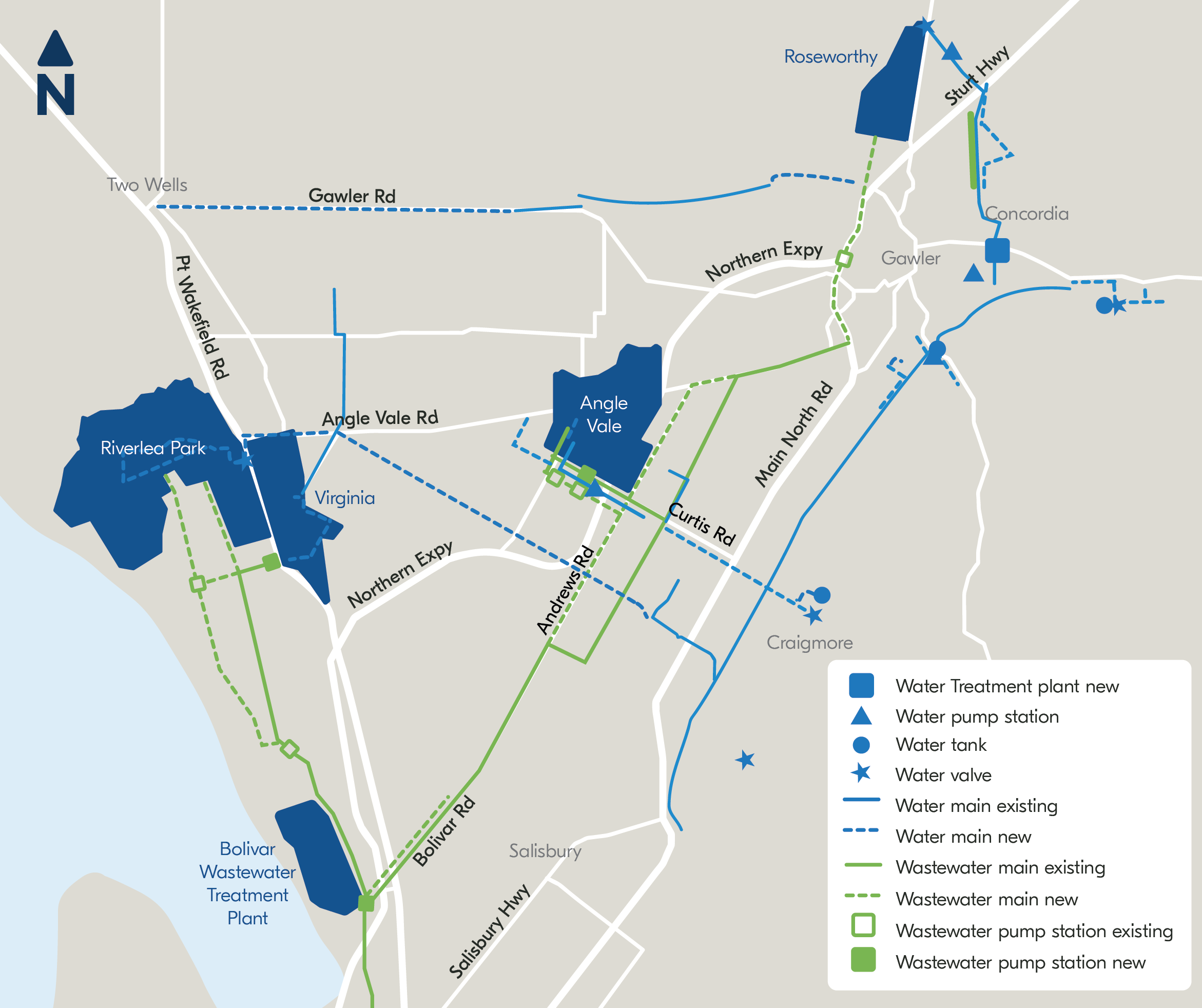
A printable version of this map can be downloaded here.
Unlocking new homes for the future
As part of the State Government’s Housing Roadmap, we’re investing $1.5 billion during the next 4 years to grow and expand our water and wastewater networks to enable an estimated 50,000 new homes to be built across South Australia. This includes an unprecedented $1.2 billion investment in critical growth infrastructure specifically across Adelaide’s north and south to directly unlock 11,000 new homes where they’re needed the most.
Delivering critical infrastructure
The planned infrastructure improvements include:
- 30 kilometres of new trunk water mains
- Two new water storage tanks
- 54 kilometres of trunk wastewater mains
- Nine new pumping stations
Work is underway with new projects starting throughout 2025 and continuing over the next 4 years.
These upgrades will facilitate housing growth in Adelaide’s northern areas, including Roseworthy, Riverlea, Dry Creek, Angle Vale, and Blakeview.
Crucially, this infrastructure lays the groundwork for future expansion. With ongoing investment, the network will be able to support up to 50,000 new homes by the 2050s, paving the way for a sustainable and thriving future.
Connect with us
Have a question or want to know more? Get in touch with our team to learn more about these essential network upgrades.
Delivery program
This delivery program provides an overview of our program of works through to 2028.