


Conditions of access
SA Water owns, operates, and manages reservoir reserves on behalf of all South Australians to ensure the reliable supply of safe, clean drinking water to more than 1.7 million people. Please enjoy, explore, and preserve our reservoir reserves, so that all visitors have a great experience.
Entry to an SA Water reservoir reserve currently open for public access is subject to the following conditions, unless expressly agreed by SA Water.
SA Water owns, operates, and manages reservoir reserves on behalf of all South Australians to ensure the reliable supply of safe, clean drinking water to more than 1.7 million people. Please enjoy, explore, and preserve our reservoir reserves, so that all visitors have a great experience.
Entry to an SA Water reservoir reserve currently open for public access is subject to the following conditions, unless expressly agreed by SA Water.
Using reservoir reserves for recreation
SA Water reservoir reserves are under surveillance, and your activities may be recorded; this includes but is not limited to CCTV footage, recording of images, voices and registration details.
When on an SA Water reservoir reserve visitors must:
- act reasonably and responsibly, be considerate of others, and must not behave in a disorderly, indecent, offensive, threatening, or insulting manner, or create any disturbance
- comply with any directions given by SA Water staff (or other persons as defined in this document)
- comply with instructions displayed on any physical signs
- comply with any directions by SA Water staff to leave an SA Water site, where SA Water staff suspect that visitors have breached the access conditions or for any other reason deemed reasonable by SA Water staff
- carry valid identification (if you are fishing you must also carry your valid fishing permit)
- be responsible for their own health and safety including looking out for hazards on land and in the water
- only enter or exit a reservoir reserve using the entrance or exit provided, unless there is an emergency
- leave all areas and facilities as you found them
- only access areas designated for public access
You may only enter the publicly accessible areas of a reservoir reserve during set opening hours.
Most reservoirs have standard opening hours which are:
- Standard Time: 7:30am – 5:00pm
- Daylight Saving Time: 7:30am – 8:00pm
Alternative opening hours are in place for Barossa, Bundaleer, Tod, Warren and the Mount Bold dam wall.
Reservoir reserves will be closed in the following circumstances:
- Total Fire Ban Days (check the CFS website)
- maintenance and operational activities
- public safety concerns
- when gates are closed and locked
A valid fishing permit is required to fish at Bundaleer, Happy Valley, Myponga, South Para, Tod, and Warren Reservoir Reserves, Aroona Dam, and Beetaloo Reservoir. For more information visit https://www.sawater.com.au/forms/buy-a-fishing-permit.
A fishing permit is required if you are:
- aged 16 or over
- under the age of 16 and are not accompanied by an adult with a fishing permit (an adult permit-holder may accompany up to five fishing minors without the need for the minors to obtain their own permit)
- responsible for a group fishing event (contact reservoirs@sawater.com.au to arrange a special group permit).
You must carry a copy of your permit and identification when fishing at a reservoir.
Only recreational fishing is permitted at reservoirs. Fishing is subject to compliance with the general conditions of access listed on this page, and with the specific conditions listed below.
- you may only fish from areas designated as available for fishing as indicated on site signage and markers
- only ‘rod and reel’ fishing is permitted. Baited nets or traps are not permitted (i.e. for yabbying or other similar purposes)
- hand-cranked electric reels may be used where they are fitted to a conventional recreational fishing rod. Commercial fishing equipment is not permitted
- you must not enter the water for the purposes of casting. If fishing from the shoreline, you must not enter the water to cast or retrieve your lure. You may only enter the water temporarily to retrieve or release a fish by wading no deeper than knee height
- if using bait, please bring your own. Bait cannot be collected at the reservoir reserve
- the use of artificial lures and flies is preferred
- the use of burley or fish attractants (including liquid, spray on or scented attractants) is not permitted
- fishing at reservoir reserves is subject to bag and size limits. Once you have reached the limit for a particular species in a day, you are not allowed to bag any more
- Golden Perch: minimum legal length 33 cm, personal daily bag limit 2 fish
- Murray Cod: catch and immediate release only
- Rainbow Trout: minimum legal length 28 cm, personal daily bag limit 2 fish
- Silver Perch: minimum legal length 33 cm, personal daily bag limit 2 fish.
- Australian Bass: catch and immediate release only
- carp, redfin and other prescribed (non-native) species caught must be removed from site and not returned
- Murray Cod and Australian Bass may be removed from the water to be unhooked, following these guidelines:
- use a strong, knotless net supporting the weight of the fish horizontally. Do not lift fish by head or suspended by gills
- keep fish wet and prevent dry or hot surfaces. Wet all handling materials and equipment prior to landing
- protect the fish slime coat, fins, gills and eyes at all times. Keep dirt and debris from the fish. Do not handle fins, gills, or eyes
- avoid fish kicking unnecessarily, or hitting hard objects or equipment. Clear space for managing fish in a kayak or canoe, or utilise shallow water if fishing from land
- utilise barbless and circle hooks
- support the belly of the fish and keep it horizontal at all times
- avoid a light line and prolonged hooking times
- have fish handling equipment available and prepared while fishing including nets, pliers, gloves and soft landing mats
- where necessary with deep hooked fish, cut line as close to the hook as possible
- the fish must be released into the water as soon as the hook is removed.
- fish must not be cleaned on an SA Water site nor any part of the fish (alive or dead) left at the reservoir
- fishing permit holders acknowledge and accept that consumption of fish caught in a reservoir is at your own risk
- you must adhere to all relevant legislation when accessing an SA Water site including the Fisheries Management Act 2007, the Marine Safety Act 2013, the Harbours and Navigation Act 1993, and all associated regulations
- in making SA Water sites available for recreation, SA Water offers no guarantees as to the suitability of the reservoir for fishing or watercraft (where authorised)
- failure to comply with the conditions of access or those of your recreational fishing permit may result in access being withdrawn or suspended, your permit being cancelled, and/or an expiation.
Kayaking and canoeing is permitted at Bundaleer, Happy Valley, Myponga, South Para, Tod, and Warren Reservoirs.
The following conditions apply in relation to paddling activities:
- only kayaks and canoes may be used
- scupper holes must be fitted with scupper plugs prior to use in a reservoir
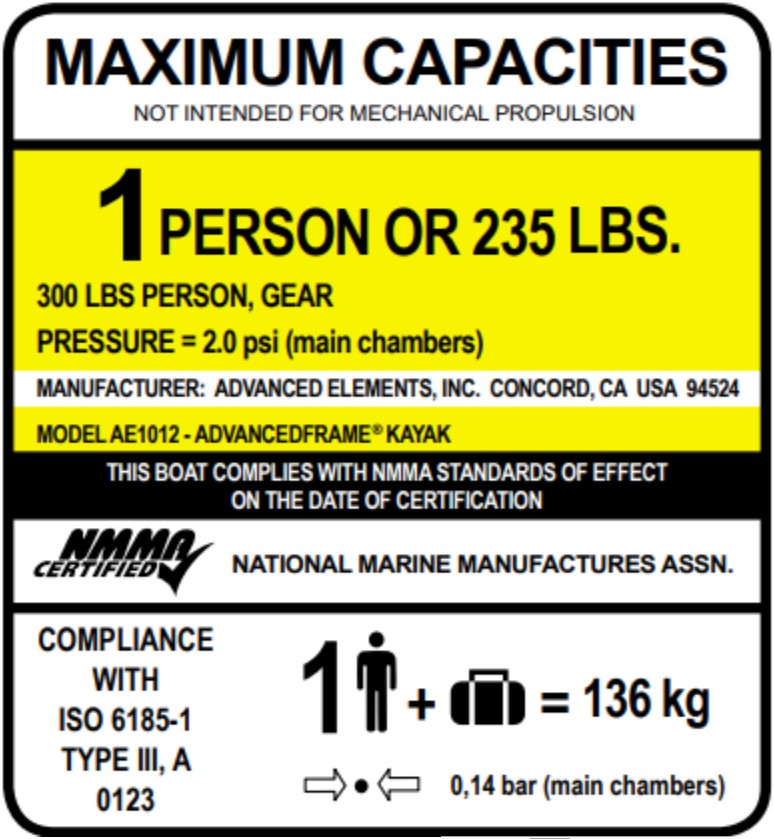
- inflatable devices are not permitted, except for inflatable canoes and kayaks complying with ISO 6185-1 and carrying a badge similar to the following:
- electric- or fuel-powered motors, or sails, must not be fitted to kayaks or canoes
- folding kayaks manufactured from corflute or coroplast are not permitted
- motorised watercraft (including battery powered) are not permitted
- stand up paddleboards, windsurfers, kite boards, row boats, sailing boats, and dinghies are not permitted
- recognising the variety in small watercraft and the potential for different designs or construction methodologies being released or becoming available, SA Water reserves the right to prohibit any watercraft that it determines to be unfit for purpose or detrimental to water quality objectives.
- queries can be directed to Reservoirs SA via email prior to purchase or construction of a watercraft to ensure compliance.
- an approved lifejacket level 100 or higher, Level 50 or 50S must be worn at all times while on the water, be of an appropriate size for the wearer, and properly fitted
- canoes and kayaks may only be launched from designated areas as indicated on signage or website
- canoes and kayaks must not be:
- used in a manner that is not intended or that results in deliberate or likely body immersion in the water such as falling into the water
- equipped with a marine or other toilet
- used in a way that causes undue disturbance or annoyance to any person fishing from land or from another vessel
- used in a way to cause nuisance or disturbance to wildlife
- used in a dangerous fashion, at a speed, or in a manner that is likely to cause injury
- painted with tar, creosote, or other phenolic compounds.
You must not do any of the following on an SA Water reservoir reserve:
- swim or wade above the knee in the reservoirs
- enter the water or other infrastructure containing water, unless it is designated or permitted
- enter the water below knee level, unless required to launch permitted watercraft or to retrieve or release a fish
- cause, directly or indirectly, damage or interference to any SA Water property or property belonging to another person
- allow an animal you own or is under your control (except assistance dogs) to enter, remain or be left on SA Water reservoir reserves. An assistance dog is an accredited dog specially trained to assist a person with a disability. An assistance dog must wear a jacket with branding from the organisation that qualified them, and their handler must carry identification showing that the dog is qualified, accredited, and serving the handler.
- urinate or defecate other than in designated toilet facilities
- spread ashes within any part of a reservoir reserve
- install any permanent or temporary fixtures including memorials
- operate any device at a volume likely to cause a nuisance
- operate remote-controlled models and toys (including boats, cars, and aircraft)
- litter, pollute or discharge substances likely to pollute land or waters
- damage or interfere with any flora (including removing plant material)
- interfere with any fauna (including feeding)
- damage, disturb or interfere with sites of cultural or historical significance
- intentionally disturb the soil, rocks or cause erosion, including fossicking, metal detecting and any digging
- erect any structures
- start a fire or leave a fire unattended (gas BBQs are permitted)
- collect firewood
- possess, handle or discharge a firearm or other weapon
- possess, carry or use explosives or fireworks
- smoke
- use an illegally modified e-bike or an unregistered vehicle
- allow a vehicle to go at a speed greater than indicated by a sign or in a dangerous manner
- use a motorbike (including e-motorbikes) beyond publicly accessible parking spaces
- allow a vehicle to be driven beyond a designated parking area or parked outside a designated parking space.
- allow a vehicle to be left in a reservoir reserve outside of operating hours.
Licence
Any commercial activity may be subject to the requirement for a licence and its terms subject to negotiation. All enquiries of a commercial nature should be directed to BusinessSolutionsAccounting@sawater.com.au.
Permit
Fishing may only be undertaken with a valid permit. See above for full conditions.
The following activities can only be undertaken on reservoir reserves when authorised by a permit. To apply for a permit, see Event and access requests: all permit holders must adhere to their permit’s specific terms and conditions.
Community Event Applications
- conducting or holding formal private or community events
- conducting any competitive event.
General Access Applications
- conducting research or other scientific surveys or experiments
- access for educational purposes
- distributing or affixing any written material to SA Water property
- rock climbing or abseiling
- accessing areas generally not available to the public
- seeking access to a culturally or historically significant site
- using any aircraft, including UAVs or other remotely piloted aircraft, including in the air space over the reservoir reserve land or its waters
- using any watercraft, including USVs or other remotely piloted watercraft
- access that assists other Government agencies to achieve critical government business without compromising SA Water’s primary recreation, land management and water quality objectives.
Entry to an SA Water site is subject to conditions as prescribed by the South Australian Water Corporation Act 1994.
Non-compliance with any of the conditions listed on this website may result in your access being withdrawn, suspended and/or your permit being cancelled.
In addition, any non-compliance with these access conditions may result in an expiation or prosecution.
Air space: the area directly above a reservoir reserve, to a height of 150m (500ft) over open areas, or 300m (1000ft) over infrastructure.
Assistance dog: an accredited dog specially trained to assist a person with a disability. An assistance dog must wear a jacket with branding from the organisation that qualified them, and their handler must carry identification showing that the dog is qualified, accredited, and serving the handler.
Bicycle: a vehicle with two or more wheels that is built to be propelled by human power through a belt, chain or gears, including electric power assisted pedal cycles with a power output of up to 250W (as defined by the Road Traffic Act 1961). This does not include electric scooters, which may not be used in reservoir reserves.
Canoe: a boat which is propelled by means of single paddle(s) and user(s) kneeling or sitting at the bow and rear of the boat. The width/length–ratio of canoes is above 1:3.
Commercial activity: an event or activity undertaken at a reservoir reserve which returns financial profit to the proponent.
Designated area: an area defined by SA Water for a particular purpose.
E-motorbike: a two or three wheeled vehicle powered primarily by an electric motor, rather than by pedalling.
Event: any public or private, ticketed or un-ticketed, planned gathering of people which is outside the normal everyday activity of the reservoir reserve (even if held regularly). An event can offer cultural, social, lifestyle and sporting experiences. Events can be held in a single day or over multiple days, but cannot be ongoing.
ISO 6185: The international standard specifying the minimum safety characteristics required for the design, manufacture, and testing of inflatable boats, including canoes and kayaks.
Kayak: a boat which is propelled by means of double-bladed paddle(s) and user(s) sitting in line in a mid-boat position. The width/length–ratio of kayaks is above 1:3.
Reservoir: the body of water, including areas accessible to the public and not, the latter delineated by a line of buoys.
Reservoir reserve: the area of land surrounding the reservoir, as well as the reservoir itself, under the care and control of SA Water.
SA Water site: all land, water, buildings, and other facilities owned by or under the control of SA Water, including the reservoir reserve(s).
SA Water staff: all SA Water employees, contractors and those authorised to undertake work for SA Water. For clarity this includes reservoir rangers.
SA Water property: all property owned or under the control of SA Water, whether fixed to the land or not.
Permit: a permit issued by SA Water granting authorisation for prescribed activities (such as holding an event, or permission to fish).
Permit Area: the area within a reservoir reserve designated for use under a permit.
You: a partnership, association, body of persons, corporate or unincorporated, or an individual.
UAV: an unmanned aerial vehicle (UAV), commonly known as a drone, is an aircraft with no human pilot, crew, or passengers on board
USV: an unmanned surface vehicle (USV), colloquially called a drone boat, drone ship or sea drone, is a boat or ship that operates on the surface of the water without a crew.
Vehicle: any form of transportation designed for movement upon wheels, including but not limited to cars, buses, motorbikes, and bicycles.